
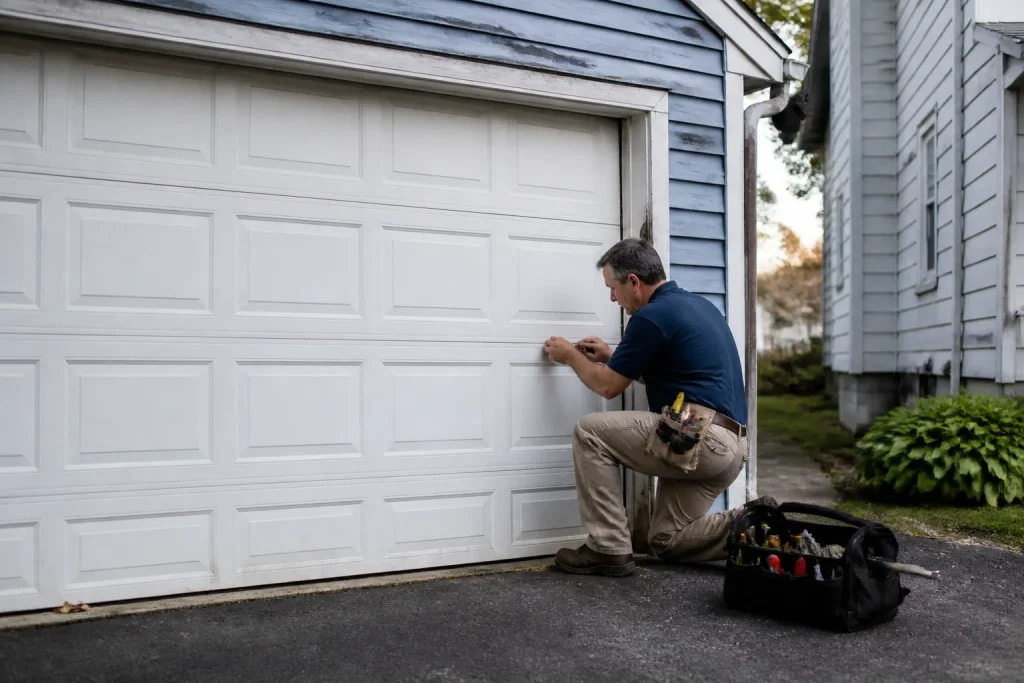
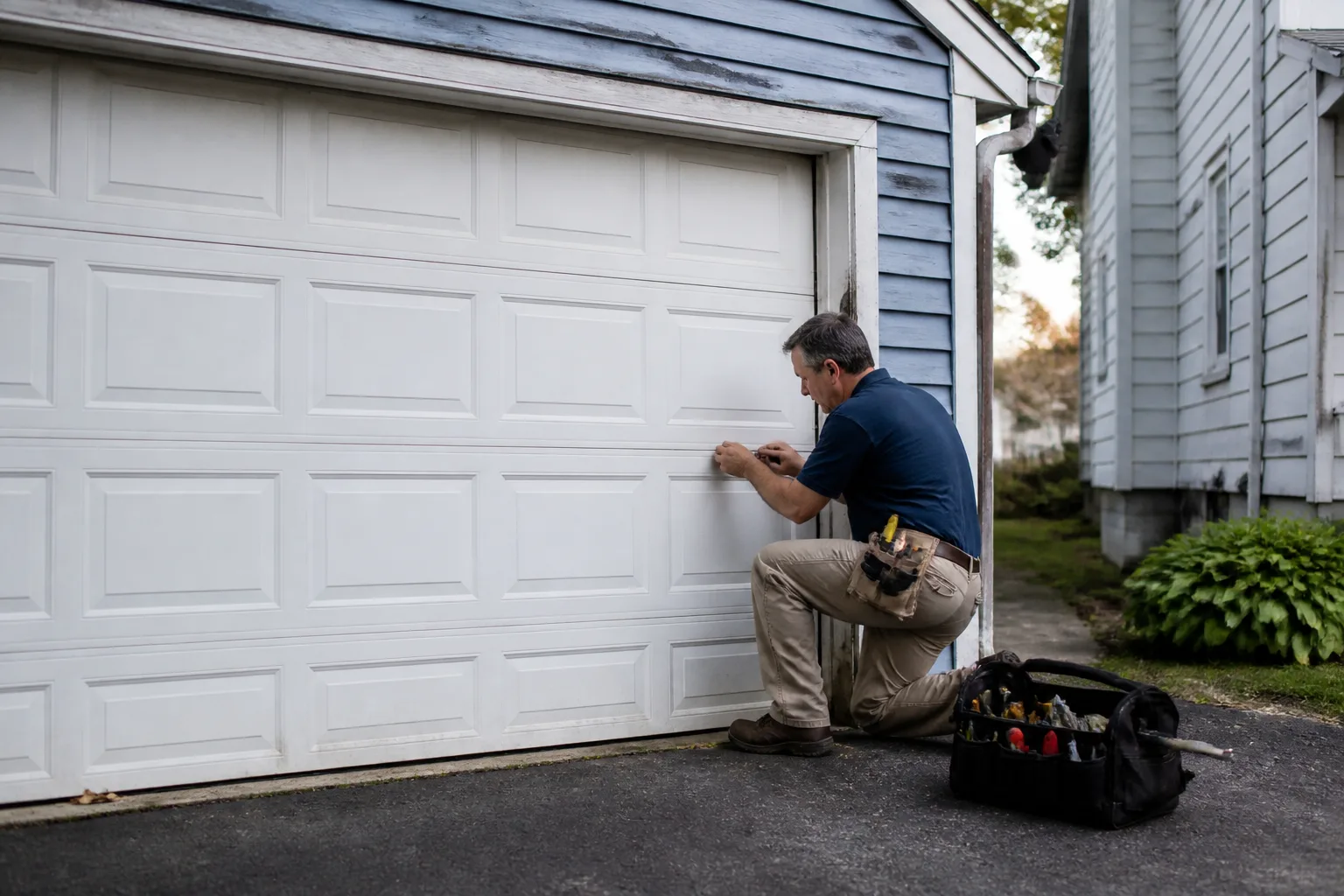
Garage Door Repair: Repair or Replace? How Bridgeport Homeowners Decide
Run the math before you run to a salesperson. Most Bridgeport homeowners decide to repair or replace a garage door based on its age, and that’s usually the least useful number on the paperwork. A door that’s fifteen years old can have years of life left; a seven-year-old door with a cracked panel and a bent track might be throwing money down a hole. The decision is a cost-per-year calculation, and once you see it written out, the answer tends to stop being scary. If you’d rather skip the math and get a straight answer on your door, call (844) 647-0405.
What’s the cost-per-year formula for a garage door?
Repair or replace comes down to one simple comparison: the cost of the repair divided by the years it buys you, versus the cost of a new door divided by its expected service life. Whichever number is lower over the same window is the better call.
Here’s the formula we walk Bridgeport homeowners through:
- Get the repair price in writing from a technician.
- Estimate how many more years that repair realistically buys the door. A spring replacement on a sound door might add several years of smooth operation; a panel replacement on a rusting frame might only prop it up for a couple.
- Divide repair cost by those years. That’s your cost per year of keeping the door.
- Do the same for a new door: price divided by how long you expect to keep it (a quality Clopay or Amarr door, well maintained, usually runs well past a decade).
- Compare the two numbers side by side.
In our experience, the crossover point lands somewhere around a repair that costs more than half the price of a new door and only resolves part of the problem. If you’re fixing one issue on a door with a solid frame, structure, and track, repair almost always wins on cost per year. When the repair price climbs toward half the replacement cost and the door is still showing wear in three other places, replacement starts to look like the cheaper long game.
Which structural conditions make repair the wrong call?
Three conditions make repair uneconomical no matter how young or old the door is: panel damage that compromises the frame, repeated cable failures, and bottom-section rot on wood doors. When you see any of these, the argument for replacement gets much stronger.
- Panel damage that reaches the frame. A dented panel is cosmetic. A panel that’s cracked through, causing the door to sag or bind, often means the structural integrity is gone and the surrounding sections are straining to compensate. Patching one panel won’t fix a frame that’s losing its shape.
- Repeated cable failures. One snapped cable is a repair. Two or three in a short span points to a deeper problem: a misaligned track, worn drums, an uneven door weight, or an opener that’s pulling harder than it should. Replacing cables over and over is the classic way to pour money into a door that needs to come down.
- Bottom-section rot on wood doors. Wood doors take on water at the bottom, where the panel sits close to the ground and moisture wicks up. Once that lower section is soft and rotted, patching it rarely holds because the rot runs deeper than the paint shows. A steel or aluminum replacement (Wayne Dalton and Amarr both make durable options) won’t have that problem.
If any of these sound familiar, a trained eye on the door is worth more than another patch job. Schedule a free estimate and let a technician tell you honestly whether repair still makes sense in Bridgeport.
Is a panel replacement a smart middle path?
Sometimes it is, and sometimes it’s just a stopgap dressed up as a solution. Panel replacement makes sense when the damage is cosmetic or surface-level, the tracks and frame are square, the springs are healthy, and the door is one where matching replacement sections are still available.
It stops making sense when the panel you’re replacing sits on a frame that’s already failing, or when the damage came from an impact that also bent the track and threw the door out of balance. A new panel on a crooked frame will wear unevenly and drag on the opener. You’re not saving money; you’re postponing the full job.
We work on Clopay and Wayne Dalton systems in Bridgeport often enough to know which models still have matching panels in circulation, and which are past the point where a partial fix pays off. When a panel swap works, it’s a genuine saving. When it doesn’t, we’ll tell you so and walk through the alternative, with the price quoted and agreed before any work starts.
How does Bridgeport’s freeze-thaw climate shift the math?
Bridgeport’s swing between freezing nights and mild days works a garage door harder than a door in a steadier climate. Every time the temperature drops below freezing and climbs back above it, the metal contracts and expands, and that cycling wears on the parts that do the most work.
A few things go first in this climate:
- Springs. Cold metal gets brittle, and springs that cycle in cold weather are under more strain. It’s worth knowing that a garage-door spring under tension can cause serious injury if it lets go while someone’s hand is near it, which is why spring work is a job for a trained technician, not a weekend project.
- Lubrication and rollers. Cold thickens grease and stiffens rollers, so a door that ran quietly in summer starts to grumble and stick by February.
- Wood bottom sections. Freeze-thaw is brutal on wood doors, especially at the base where moisture gathers and frost gets a foothold, speeding up the rot that makes replacement the practical answer.
- Weather seals. Seals and bottom weatherstripping crack faster with temperature swings, which lets snow and cold air in under the door.
What this means for repair-or-replace: a wood door in Bridgeport with rot at the bottom is on a clock that runs faster here than it does inland. And a steel or insulated door that stays sound through the seasonal cycles earns its keep. If you’re already calling us for a garage door repair, ask the technician to check the seals and bottom section on the same visit.
Do insulation and energy performance count in the replace decision?
Yes, and they deserve a real number on the spreadsheet rather than being waved away as an upgrade pitch. An uninsulated door lets heat out of the garage every winter, and an attached garage shares a wall with the house. That heat loss shows up in your energy bills over the years.
When you’re already facing a replacement, the difference in price between a bare steel door and an insulated one is often modest. Over the life of the door, the insulated model can pull its weight in reduced heat loss and a quieter, sturdier door that isn’t as bothered by the cold. For anyone in Bridgeport who uses the garage as part of the living space, or who keeps a conditioned room above it, insulation is a genuine financial factor, not a flourish.
It’s not a reason to replace a door that doesn’t need it. But when the cost-per-year math already points toward replacement, choose the insulated option. It’s the one decision you don’t get a second chance at without paying for another door.
The Bottom Line
Make the call on the math, not the age on the label. Most doors are worth repairing if the frame is sound, the damage is limited, and the repair cost stays well under half a new door. Those three structural conditions – frame damage, repeated cable failures, and wood rot at the bottom – are the signals to stop fixing and start replacing. A legitimate panel swap is a real middle path when the frame and springs are healthy; it’s a waste when they aren’t. And in a Bridgeport freeze-thaw climate, insulation and material choice belong in the calculation, not just the aesthetics.
Key takeaways to keep handy:
- Divide repair cost by the years it buys, then compare to new-door cost per year.
- See repeat failures or frame damage? Replace, regardless of age.
- Panel replacement works only when the structure underneath is square and healthy.
- Insulation is a financial factor, not just a comfort upgrade.
If you’d rather not run the numbers alone, we can do it with you. We handle repair, opener work, and installation from one call, on Clopay, Amarr, Wayne Dalton, and the openers that run them. Call (844) 647-0405 for a free estimate. We answer 24/7. Fast dispatch from 7am to 7pm, Sunday through Friday.
Frequently Asked Questions
Repair it if the frame is sound, the damage is limited, and the repair cost stays well under half the price of a new door. Replace it if the panels have damaged the frame, the cables keep failing, or a wood bottom section is rotting. The cost-per-year comparison is the clearest guide. For an exact quote on either path, call (844) 647-0405 – estimates are free.
Yes, when the track, frame, and springs are healthy and a matching panel is still available. It’s not worth it when the frame is bent or the damage came with structural impact, because a new panel on a failing frame wears out fast. A technician can tell you in a few minutes which situation you’re in. Call (844) 647-0405 to get that answer.
No. The price is quoted and agreed before any work starts, and the written estimate sets the final number. If we find something that changes the scope, we’ll walk you through it and get your approval first, not surprise you with an invoice. Call (844) 647-0405 for a free written estimate.
The local pro we connect you with is licensed and insured as their state requires, and our technicians have up to 11 years of experience. Springs and cables that fail under load can cause serious injury, so we send people trained to handle them safely. Call (844) 647-0405 to book a visit. We answer 24/7. Fast dispatch from 7am to 7pm, Sunday through Friday.
Written by the team at Bridgeport Garage Door Repair Pros.
Need Garage Door Help?
Call Bridgeport Garage Door Repair Pros - the local pro we connect you with is licensed and insured, here with fast help in Bridgeport.
(844) 647-0405